TMJ, Jaw Tension, and the Hidden Cost of "Wired but Tired": How Massage and Yoga Help
If you've caught yourself clenching your jaw during a stressful email, or waking up with soreness near your ears that has nothing to do with your teeth, you're experiencing one of the most common — and most overlooked — physical signs of chronic stress: jaw and temporomandibular joint (TMJ) tension.
What is TMJ tension, and why does it happen?
TMJ tension is tightness or dysfunction in the temporomandibular joint and surrounding muscles, frequently caused or worsened by chronic clenching and grinding that many people do unconsciously in response to ongoing stress. Unlike an injury with an obvious cause, TMJ tension often builds slowly, showing up as jaw soreness, headaches, clicking or popping when opening the mouth, or pain that radiates into the neck and shoulders.
The connection to stress isn't incidental — the jaw is one of the most common places the body stores tension when the nervous system is stuck in a low-grade activated state, even when a person doesn't feel overtly "stressed" in the moment.
Is there research connecting massage to TMJ relief?
Yes — clinical case studies have found that massage therapy measurably improves TMJ symptoms, including one case report documenting an increase in maximal jaw opening from 3.1 to 3.8 centimeters, decreased muscle hypertonicity, and a drop in reported pain from 7 out of 10 to 3 out of 10 following massage treatment (published research on TMJ dysfunction and massage therapy). Additional research on manual and deep transverse friction massage techniques has similarly shown improvements in jaw function, pain, and mouth-opening range for people with temporomandibular disorders.
This matters because it shows TMJ tension isn't purely structural or permanent — targeted bodywork produces measurable physical change, not just temporary relief.
Why does jaw tension show up even in people who "aren't that stressed"?
Chronic stress doesn't require a dramatic, identifiable trigger to accumulate in the body — low-grade, constant demands like deadlines, notifications, and multitasking keep the nervous system slightly activated, and that activation often gets stored as unconscious muscular guarding in the jaw, shoulders, and hips. This is the physical reality behind the phrase "wired but tired": doing everything that's supposed to help — exercising, eating well, sleeping enough — while still carrying tension the body hasn't been given a chance to release.
Jaw clenching in particular tends to happen during sleep or during focused concentration, which means many people have no idea they're doing it until a massage therapist or dentist points out the resulting soreness or wear.
How does massage actually help release jaw tension?
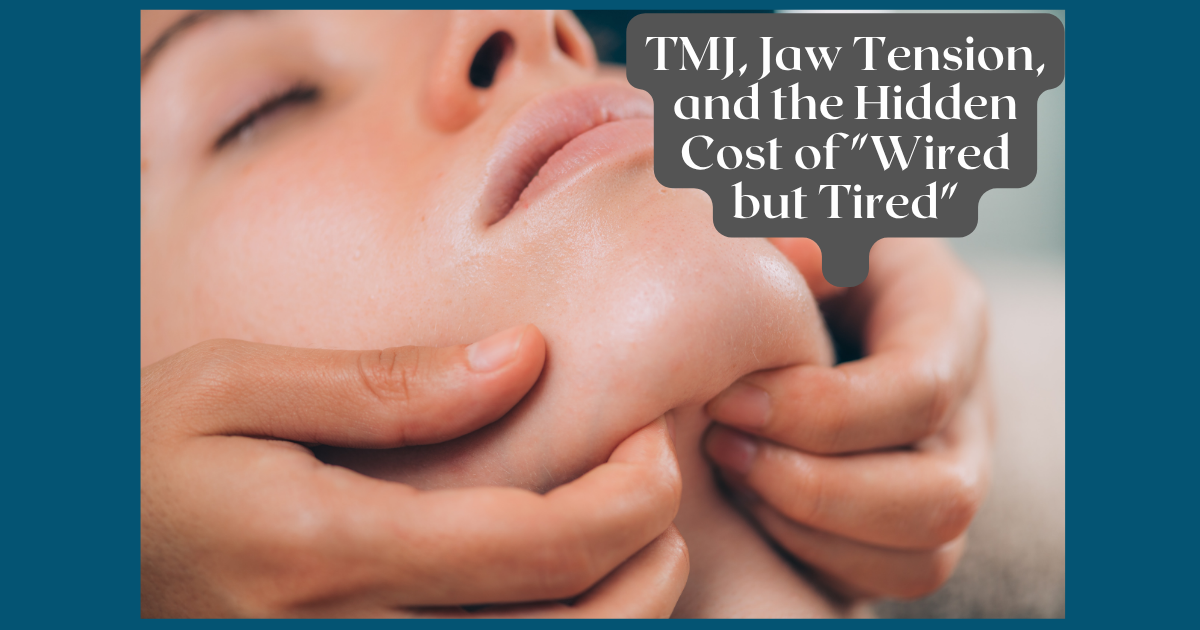
Massage helps release TMJ tension by directly working the masseter, temporalis, and surrounding muscles to reduce hypertonicity, while also sending the nervous system a broader signal of safety that reduces the unconscious drive to clench. This is why a targeted treatment like Palestra's TMJ Buccal massage focuses specifically on this region rather than treating jaw tension as a side effect to address during a general full-body session.
Because jaw tension is often a symptom of broader nervous system activation, addressing it in isolation sometimes provides only temporary relief — pairing targeted massage with practices that support overall regulation tends to produce more lasting change.
Can yoga help with jaw and facial tension too?
Yes — breath-centered yoga practices help release jaw tension indirectly by calming the nervous system's overall activation level, which reduces the unconscious clenching response even outside of class. Certain yoga cues — consciously softening the jaw, unclenching the teeth, relaxing the tongue — are also commonly built into class instruction specifically because jaw tension is such a widespread, low-awareness holding pattern.
Combining a regular yoga practice with periodic massage tends to work better than either alone: yoga helps prevent new tension from accumulating, while massage addresses tension that's already built up in the tissue.
Frequently Asked Questions
Is TMJ tension always caused by stress? Not always — some TMJ dysfunction has structural or dental origins — but chronic stress-related clenching and grinding is one of the most common contributing factors, especially when symptoms build gradually rather than following an injury.
How quickly can massage improve jaw tension? Documented case studies have shown measurable improvement in jaw mobility and pain after a course of massage treatment, though the exact timeline varies by individual and by how long the tension has been present.
Should I see a dentist or a massage therapist for jaw pain? Both can play a role — a dentist can rule out structural or bite-related causes, while a massage therapist trained in TMJ-focused work can address the muscular tension component directly.
What Palestra service specifically targets jaw tension? Palestra offers a dedicated TMJ Buccal massage focused specifically on the jaw and surrounding muscles; general relaxation and deep tissue massage can also help as part of a broader stress-reduction approach.
Can yoga alone resolve jaw tension, or do I need massage too? Yoga helps reduce the overall nervous system activation that drives unconscious clenching, but existing muscular tightness in the jaw often responds faster to direct bodywork — many people find the combination most effective.